
Is there a scent on dog pee pads? Sometimes yes, sometimes no. At Carecon™, we would answer this question very directly: some dog pee pads are scented, some are unscented, and “scented” can mean more than one thing. In the market today, you can find unscented pads, fresh-scented pads, lavender-scented pads, mountain-fresh-scented pads, grass-scented pads, and pads with a built-in dog attractant. Official product pages from AKC Shop, Four Paws, Hartz, and Simple Solution all show that these variations are already standard in the category.
That distinction matters because many buyers assume every pee pad smells the same, or that every scented pad is designed for the dog. In reality, some scents are there to help guide the dog, while others are mainly there to make the home smell fresher for the owner. AKC product listings mention fresh-scented pads with a built-in attractant, Four Paws describes pads with a built-in targeted attractant and even a familiar grass scent in some versions, and Hartz sells both unscented and scented odor-eliminating versions.
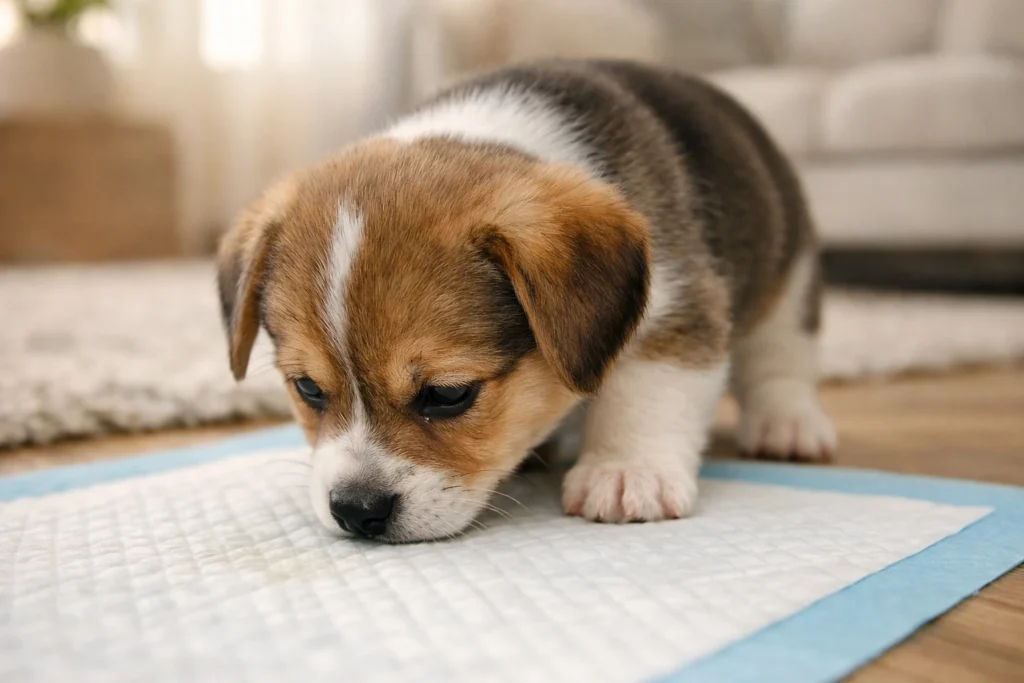
What “Scent” On A Dog Pee Pad Usually Means
When people ask whether dog pee pads have a scent, they are usually talking about one of two product features.
The first is an 引诱剂气味. This is meant to help draw the dog toward the pad or encourage the dog to recognize the pad as the right place to toilet. AKC Shop describes dog training pads with a built-in attractant, Four Paws says its pads have a built-in targeted attractant, and NaturVet’s Potty Here training spray says its attractant scent encourages dogs to urinate wherever it is applied, including on puppy pads.
The second is a freshness or odor-control scent. This is usually aimed more at the human side of the experience. AKC sells fresh-scented and fresh-cut-grass-scented pads, Hartz sells mountain fresh and lavender-scented pads, and Simple Solution offers lavender-scented training pads. These product descriptions consistently frame the added fragrance as a way to reduce or inhibit unwanted odors in the home.
Some products combine both ideas in one pad. For example, AKC’s fresh-scented pads are also described as having a built-in attractant, which means the pad may contain both an owner-facing fragrance and a dog-facing training cue. That is why the word 有香味 can be confusing unless the product description is read carefully.
Are All Dog Pee Pads Scented?
No. Not all dog pee pads are scented.
This point is important because buyers often assume fragrance is standard. It is not. Hartz sells unscented dog pads and explicitly labels them as unscented, while the broader market also includes many unscented training pads sold through major retailers. In other words, a dog pee pad may have a scent, but there is no rule that it must.
So the more accurate answer to the article title is this: there can be a scent on dog pee pads, but there does not have to be one. That is a better answer for buyers because it reflects how the category is actually sold. Some owners want fresh scent or grass scent. Some want a built-in attractant. Some want no added fragrance at all.
At Carecon™, we think this is one of the simplest ways to make the product category easier to understand. A pee pad is not just “scented” or “unscented.” It may be unscented, fragrance-scented, attractant-scented, or a combination product.
Why Brands Put Scent On Pee Pads
The main reason is that dogs live in a scent-driven world. VCA says dogs have more than 100 million sensory receptor sites in the nasal cavity, compared with about 6 million in people, and that the canine brain devotes far more space to odor analysis than the human brain does. That does not prove every scented pad will work equally well, but it explains why smell is such a logical product feature in dog training products.
There is also a behavior reason behind it. VCA says urine marking is normal scent-marking behavior and that dogs may use urine to communicate or label territory, even indoors. Since dogs already use scent and urine as part of how they understand spaces, it makes sense that some manufacturers try to use smell cues to help define the potty area.
This is why attractant sprays and attractant pads exist. NaturVet says its training spray uses a unique attractant scent to encourage dogs to urinate where it is sprayed, and product pages from AKC and Four Paws describe built-in attractants in the pad itself. In other words, scent is not being added at random. It is being used as a training cue.
The other reason brands add scent is more practical and more human-centered. Used pee pads can smell bad. Product pages for AKC, Hartz, and Simple Solution all describe scented pads as helping reduce, neutralize, or inhibit unwanted odors in the home. That means a scented pad is often doing two jobs at once: helping guide the dog and making the indoor space more tolerable for people.
Does The Scent Actually Help Dogs Use The Pad?
Sometimes, yes. But the honest answer is that scent is usually a support tool, not the real foundation of potty training.
AKC, VCA, and Humane World all say the same bigger thing in different ways: house training depends on consistency, supervision, routine, and positive reinforcement. VCA says house training is about teaching dogs the habit of toileting in the right spots, and Humane World says patience, consistency, and positive reinforcement are the foundation of successful potty training. AKC’s potty-pad training guide says pads can be useful, but owners still need to take puppies to the pad frequently, watch for signs, and reinforce correct behavior.
That means a built-in attractant or grass scent may help a dog notice 或 investigate the pad, but it does not replace the training process. If the owner is inconsistent, if the pad keeps moving, or if the dog is not taken there at the right times, the scent feature alone is unlikely to solve the problem.
From our Carecon™ point of view, this is where honest product messaging matters. A scent can make a pad more helpful. It should not be sold as a magic switch. A strong pee pad product still needs to be paired with good household routine.
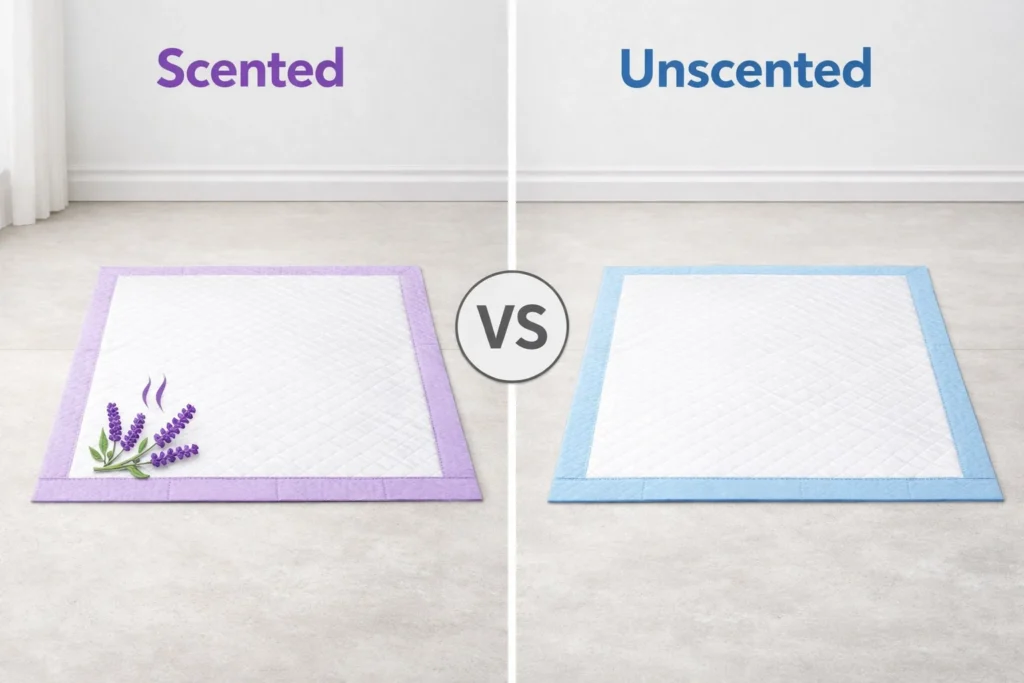
What Types Of Scent Are Common On Dog Pee Pads?
The most common scent types in the market are fairly easy to spot once you know what to look for.
One common type is fresh scent. AKC sells fresh-scented training pads, and these are positioned as helping control foul odors while also supporting house training.
Another is grass scent. Four Paws describes a familiar grass scent in one of its attractant pad products, and AKC also sells fresh-cut-grass-scented training pads. This type of scent is especially easy to understand from a marketing angle because it tries to connect indoor potty behavior with the smell of outdoor bathroom spots.
A third type is lavender or other household fragrance. Hartz sells lavender-scented dog pads, and Simple Solution offers lavender-scented training pads as well. These products are mainly framed around freshness and odor elimination rather than around dog behavior alone.
And then there are unscented pads, which are also a clear part of the category. Hartz officially offers unscented pads, which makes it clear that added fragrance is optional, not universal.
So Which Kind Of Scent Is For The Dog, And Which Is For The Owner?
In practice, the answer is usually this: attractant scent is mainly for the dog, while freshness scent is mainly for the owner.
AKC, Four Paws, and NaturVet all use language like “built-in attractant,” “targeted attractant,” or “encourage dogs to urinate where the product is sprayed.” That language is clearly about dog behavior.
By contrast, AKC’s fresh-cut-grass-scented pads, Hartz’s mountain fresh and lavender pads, and Simple Solution’s lavender-scented pads are described in terms of freshness and odor control in the home. Those claims are aimed much more at the human experience of living with indoor potty products.
Of course, some products mix both purposes together. A fresh-scented pad with a built-in attractant is trying to help both the dog and the owner at once. That is why buyers need to decide what problem they are actually trying to solve. Do they want a pad that helps cue the dog? A pad that makes the room smell better? Or both?
When A Scented Pee Pad Makes The Most Sense
A scented or attractant-based pad usually makes the most sense in early training, indoor potty routines, or in homes where the owner wants more odor control around the pad area.
AKC says pads can play a role for very young puppies, apartment dwellers, or owners who need an indoor option during the housetraining phase. In those settings, adding an attractant or a familiar grass scent may make the potty area easier to identify.
A scented pad may also make sense when the main complaint is not training failure but home odor. Product pages from Hartz, AKC, and Simple Solution all make it clear that scented pad lines are often positioned as odor-reducing products. For a buyer in a small apartment or shared room, that can be a meaningful benefit.
At Carecon™, we would frame this very simply: if the buyer needs training support plus freshness, scented pads are often a logical choice. If the buyer only wants a basic absorbent surface and does not care about added fragrance, unscented pads are still a valid option.
When An Unscented Pee Pad May Be The Better Choice
Unscented pee pads make sense when the buyer wants a more neutral product or simply does not want added fragrance in the home. The existence of clearly labeled unscented lines from Hartz and the large unscented category sold through major pet retailers shows that this is already an important buyer preference in the market.
They may also make sense when the dog already understands the pee-pad routine well enough that the owner does not feel a need for added attractant or extra fragrance. This is partly an inference from how training works: once routine and positive reinforcement are established, the owner may not need as many added product cues. VCA, Humane World, and AKC all emphasize that routine and reinforcement are the core drivers anyway.
From our perspective, that is the real choice. Not “scented versus unscented” as a trend question, but “which product feature matches the real use case better?”
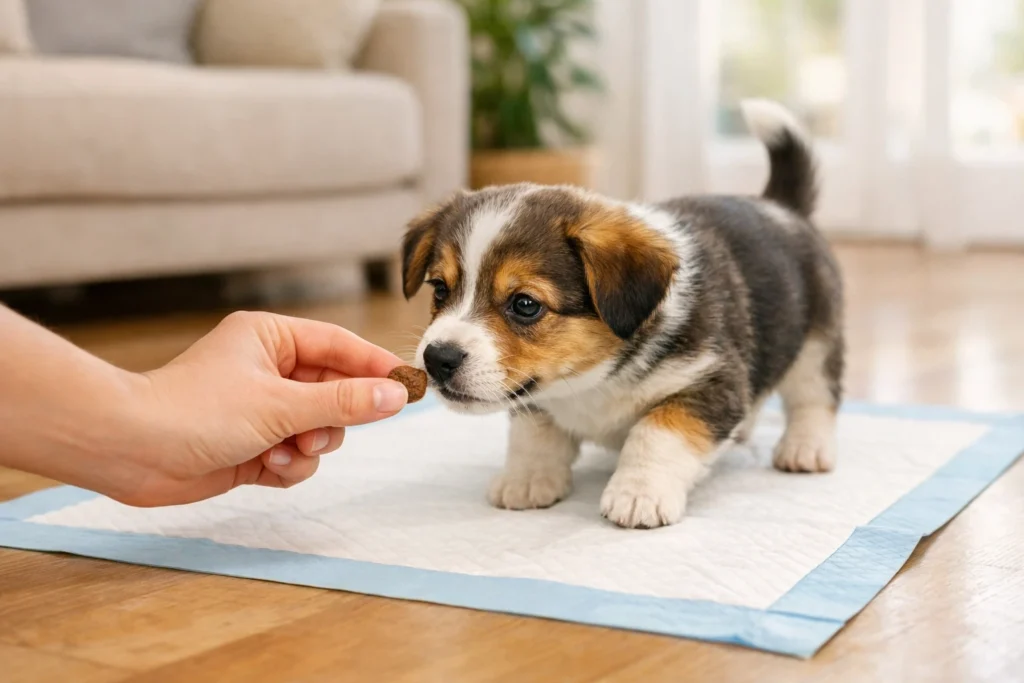
How We See It At Carecon™
在 Carecon™ Carecon™ Carecon™ Carecon™, we believe the most accurate answer is also the most useful one: yes, there can be a scent on dog pee pads, but it depends on the product and the purpose of the scent. Some pads are unscented. Some use fragrance for freshness. Some use attractants to encourage pad use. Some combine both.
We also believe scent should be positioned as a feature, not a miracle. Dogs are highly scent-oriented animals, and product cues based on smell can make sense. But the strongest training results still come from consistency, supervision, keeping the pad in one place, and rewarding success quickly. That larger training picture is what AKC, VCA, and Humane World consistently reinforce.
For a brand message, the better claim is not “all pee pads have scent” and not “scent alone trains the dog.” The better claim is: some pee pads use scent to support training or odor control, and the right choice depends on what the home actually needs.
结论
Is there a scent on dog pee pads? Sometimes, yes. But not always. The market includes unscented pads, fresh-scented pads, grass-scented pads, lavender-scented pads, and pads with built-in attractants. So the most accurate answer is that dog pee pads may have a scent, but scent is an optional product feature rather than a universal standard.
For Carecon™, the clearest way to explain this to buyers is simple. If the goal is training support, look for attractant-based pads. If the goal is a fresher-smelling room, look for fragrance or odor-control pads. If the goal is a neutral product, choose an unscented pad. The scent matters, but the training routine still matters more.