
Are doggie diapers a good idea? Yes, they can be a good idea in the right situation. But they are not a cure, and they are not right for every dog. At Carecon™, we see doggie diapers as a practical care product. They help manage a mess. They protect floors, bedding, and furniture. They can also make life easier for dogs that leak urine, recover from injury, go into heat, or cannot get outside in time. Still, the best answer depends on why the dog needs the diaper in the first place. AKC says dog diapers can be helpful for dogs in heat, for dogs with reduced bladder control, for some senior dogs, and in some recovery cases. The same AKC guidance also says diapers are mainly a sanitary tool, not a substitute for veterinary care or training.
That distinction matters. A diaper can manage the symptom. It usually does not solve the cause. If a dog is leaking because of urinary incontinence, the cause may still need medication or a medical workup. If a dog is peeing indoors because of poor house training, the dog still needs a clear routine and positive reinforcement. VCA says house training depends on consistency, supervision, and positive reinforcement. AKC says even if you use diapers during training, you still have to take the diaper off, let the puppy out, and reward the dog for going in the right place.
From our point of view at Linyi CareCon Import & Export Co., Ltd., that is the most honest way to present the category. Doggie diapers are useful. They can be a very smart choice. But they are best used as part of a broader care plan, not as a shortcut.
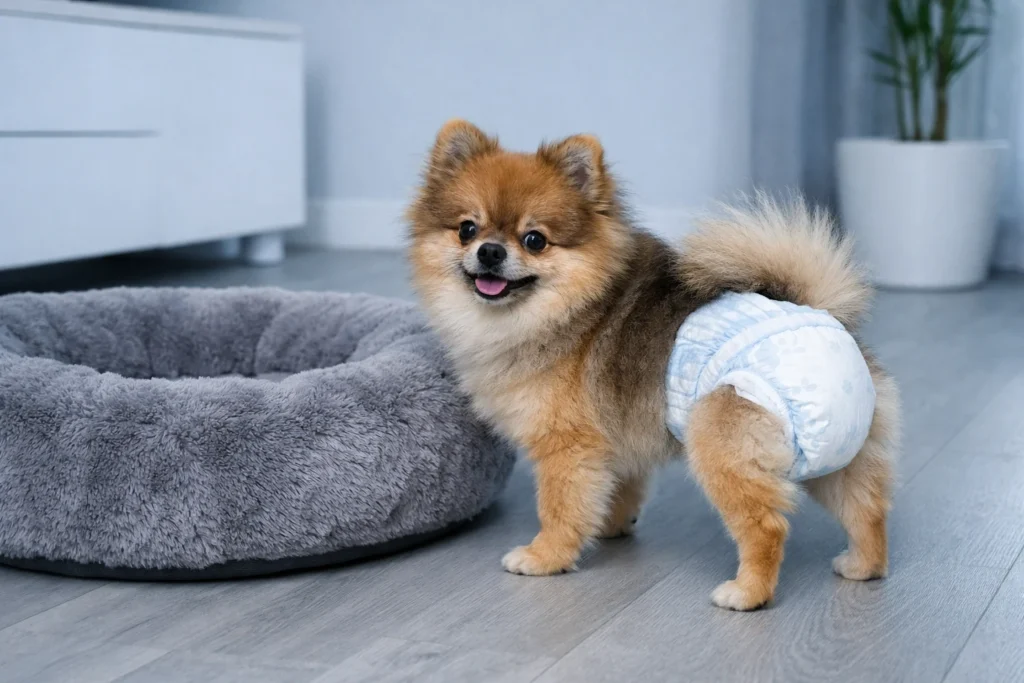
When Doggie Diapers Are A Good Idea
One of the clearest cases is urinary incontinence. MSD Veterinary Manual defines urinary incontinence as loss of voluntary control of urination, with constant or intermittent leakage. It notes that incontinent dogs may leave urine where they were lying down or may dribble while walking, and the skin around the genitals can become irritated from urine exposure. In that kind of situation, a diaper can help keep the dog, the bedding, and the house cleaner while the dog is being diagnosed or treated. AKC also says diapers can help when a medical issue reduces a dog’s bladder control.
Doggie diapers can also be a good idea for female dogs in heat. AKC says an unspayed female dog in heat may have bleeding and more frequent urination, and a diaper can help contain the blood and reduce licking. AKC also makes one important warning very clear: a diaper does not prevent mating. So in this use case, the diaper is for cleanliness and comfort, not birth control.
A third good use case is short-term recovery after surgery or injury. AKC says diapers can be a temporary aid after surgery or injury when a dog has trouble supporting their weight while peeing or when nerve function is expected to improve. That can be helpful in real life, especially for dogs with mobility problems or temporary weakness. But AKC also says owners should check with the veterinarian first if the diaper may cover an incision or an injury site.
They can also be helpful for senior dogs. Blue Cross says behavior changes in older dogs can be a sign of illness or pain, not just normal aging. AKC says senior-dog accidents can come from many causes, including pain, kidney disease, sensory decline, cognitive decline, or urinary incontinence. In those cases, AKC says diapers or belly bands can help some dogs get through the night or other periods when they cannot be taken outside, as long as they are changed regularly for hygiene.
There is also a role for diapers in male marking management, but here the product choice matters. VCA says management for urine marking may include a belly band, which is a diaper-like wrap for male dogs. AKC also points out that male dogs are often more likely to show marking, excitement urination, or submissive urination than true incontinence. In those cases, the diaper or wrap helps protect the house while behavior work is happening. It is a management tool, not the final fix.
When Doggie Diapers Are Not A Good Idea
Doggie diapers are not a good idea when they are being used to hide a medical problem. AKC says that if a dog shows reduced bladder control, more frequent urination, strong-smelling urine, cloudy urine, blood in the urine, pain while urinating, or stopping and restarting mid-stream, the dog should be seen by a veterinarian. MSD Veterinary Manual also explains that difficulty urinating, passing only small amounts, or being unable to urinate may point to a voiding disorder or even obstruction. That means the diaper should never become an excuse to delay diagnosis.
They are also a poor choice for diarrhea. AKC says diapers are not a good option if a dog has diarrhea because you do not want to keep diarrhea close to the dog’s body. In that case, quick cleanup and a safer bathroom setup make more sense than sealing the mess against the skin.
They are not ideal when the dog will be left alone without supervision. AKC warns that an unsupervised dog may tear off the diaper or ingest pieces of it, which can become dangerous. Even if the dog does not eat it, the diaper may come off, bunch up, leak, or rub the skin. That is why supervision matters, especially when a dog is new to wearing one.
They are also not a good idea when the owner plans to use them as a full answer to house training. VCA says house training is about teaching the habit of toileting in the right place. AKC says that even if diapers are used temporarily during potty training, the dog still needs outdoor trips and praise for success in the correct place. So if the goal is long-term training, the diaper can only play a small support role.
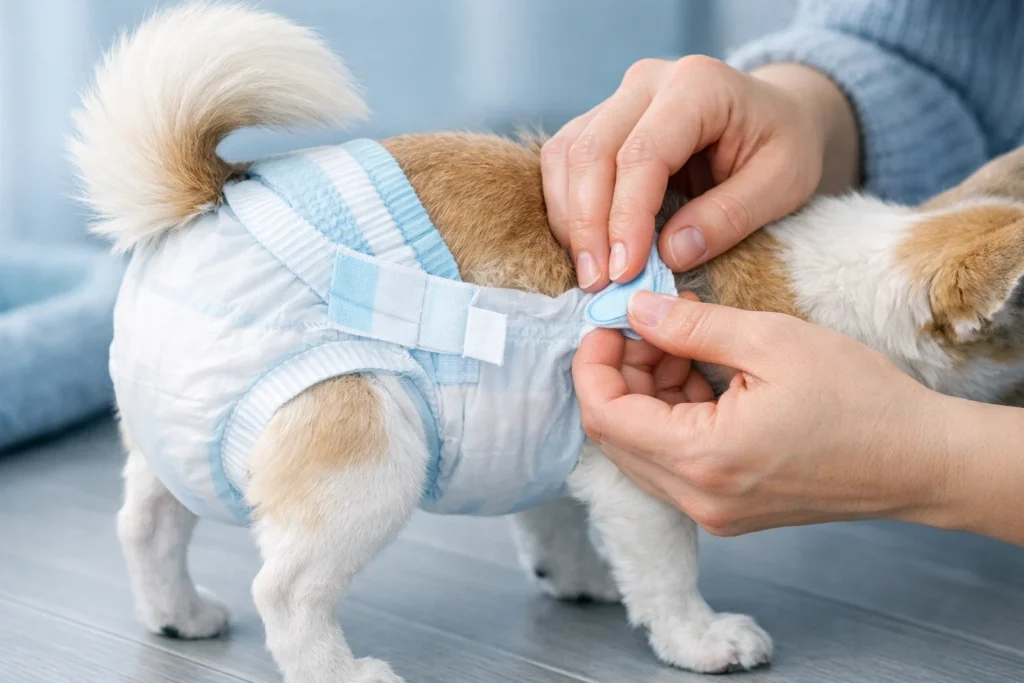
What Doggie Diapers Can Help With
Doggie diapers help with cleanup and containment first. That is their main value. They can keep blood, urine, or light discharge off floors and soft furnishings. AKC describes them as primarily a sanitary measure. That sounds simple, but it matters a lot in a real home. A product that lowers daily cleanup can reduce stress for both the owner and the dog.
They can also help with comfort and routine when the dog has a condition that cannot be fixed right away. AKC’s senior-dog guidance says some dogs can use diapers or belly bands overnight or when outdoor access is difficult, provided hygiene is maintained. That kind of use is not about convenience alone. It is about helping the dog cope with a problem the dog may not be able to control.
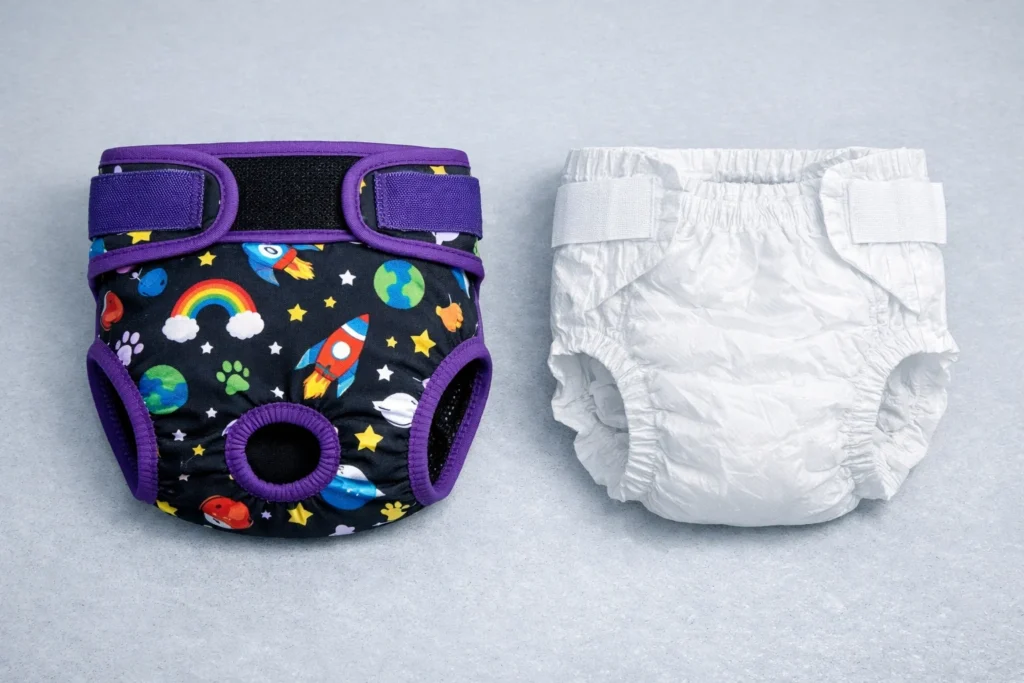
For male dogs, a belly band may be the better choice than a full diaper. AKC explains that belly bands wrap around the midsection and are often used for male dogs, while full diapers cover the rear and include a tail hole. That product difference matters because buyers often search for “doggie diapers” when what they really need is a male wrap for marking or urine dribbling.
Doggie diapers may also support short-term behavior management. VCA says belly bands may be used while working through marking behavior. That is a helpful point because it keeps expectations realistic. The wrap protects the home while the dog learns new habits or while the owner and behavior professional work on the cause.
What Doggie Diapers Cannot Do
Doggie diapers cannot diagnose the problem. If a dog suddenly starts leaking, peeing in sleep, dribbling while walking, or showing pain while urinating, that is a veterinary issue first. MSD Veterinary Manual and AKC both make clear that abnormal urination patterns can have medical causes that need proper evaluation.
They also cannot replace training. VCA says dogs can be taught to toilet outdoors, indoors on pads, or in another specific area, but the learning process still depends on consistency and reward. A diaper may buy time. It does not teach the bathroom habit by itself.
They cannot serve as contraception. AKC says clearly that dog diapers do not stop a male dog from mating with a female dog in heat. This point is important because some owners confuse hygiene control with breeding prevention. These are not the same thing.
They also cannot make poor hygiene safe. AKC says a wet or dirty diaper can lead to rash, itching, inflammation, and bacterial infection if it is not changed often enough. MSD Veterinary Manual also notes that urine exposure around the genital area can cause dermatitis from urine scalding. So the diaper only helps if the owner changes it on time and keeps the skin clean.
How To Use Doggie Diapers Safely
The first rule is fit. AKC says there are variations in fit and absorbency, so owners should measure carefully and choose the correct size and absorbency level. A diaper that is too loose will leak or slip. A diaper that is too tight can rub the skin and make the dog miserable.
The second rule is frequent changing. AKC says dog diapers should be changed often. It compares this to baby care and warns that a wet or dirty diaper can cause rash and infection. AKC also recommends using wipes to clean the dog during changes. That is one of the most important care points in the whole category.
The third rule is supervised introduction. AKC says dogs that are not used to diapers should get praise and a positive introduction. It also warns against leaving a dog alone in a diaper. So the better method is gradual use, calm handling, and close observation during the first sessions.
The fourth rule is match the product to the problem. A female in heat may need a full diaper. A male dog that marks indoors may do better with a belly band. A senior dog with broad leakage may need a different design than a young dog with only occasional accidents. AKC’s product guidance makes this distinction clear.
Notre point de vue sur Carecon™
At Carecon™, we believe doggie diapers are a good idea when they solve a real care problem without replacing proper care. They can be a strong solution for heat management, temporary accident control, some senior-dog situations, male marking management, and some recovery periods. They help owners protect the home. They can also reduce stress in the daily care routine. AKC, VCA, Blue Cross, and MSD Veterinary Manual all support the same broader principle: management tools are useful, but they work best when the cause is understood and hygiene is handled well.
We also believe buyers need a more accurate message than “just put a diaper on the dog.” The better message is this: choose the right style, get the fit right, change it often, watch the skin, and do not ignore new urinary problems. That is how a doggie diaper becomes a helpful pet-care product instead of a messy compromise.
Conclusion
Are doggie diapers a good idea? Yes, they often are. They are a good idea when the goal is to manage heat discharge, protect the home during incontinence, support a senior dog, handle short-term recovery, or control marking while behavior work is underway. They are not a cure for urinary disease, not a replacement for house training, and not a safe answer if the dog has diarrhea or must be left alone unsupervised.
For Carecon™, the best way to describe doggie diapers is simple: they are a useful management tool. Used well, they make life cleaner and easier. Used badly, they can hide medical problems or cause skin trouble. The product is good when the plan around it is good too.