
One of the most common problems with indoor potty training is not the pad itself. It is the movement. The dog steps on the pad, the pad slides, the dog gets startled, and the whole setup starts to fail. Some dogs then stop trusting the pad. Some begin missing the edge. Some paw at it, bunch it up, or drag it across the floor. At Carecon™, we see this as both a training problem and a product-use problem. The good news is that it is usually fixable.
If you are asking how to keep a dog pee pad from slipping, the short answer is this: keep the pad in one place, make the potty area more defined, and use the right support under or around the pad. The most effective fixes are usually a pad holder tray, adhesive corners, better placement, a larger pad, or a contained potty area. These ideas fit well with the broader training guidance from AKC, Blue Cross, Humane World for Animals, and Preventive Vet, which all point to the same core rule: dogs learn better when the toilet area is stable, clear, and easy to recognize.
A sliding pad may look like a small issue, but it can create a chain of bigger ones. If the dog feels the surface move under its paws, it may hesitate to step on the pad again. If the pad shifts while the dog circles, the dog may end up peeing beside it instead of on it. Preventive Vet notes that a holder tray can help because it creates a raised edge, which makes the potty zone easier for a dog to identify. It also says some senior dogs gain confidence when the pad does not slip on hard floors. That is a very practical point. Stability is not only about neatness. It is also about confidence.
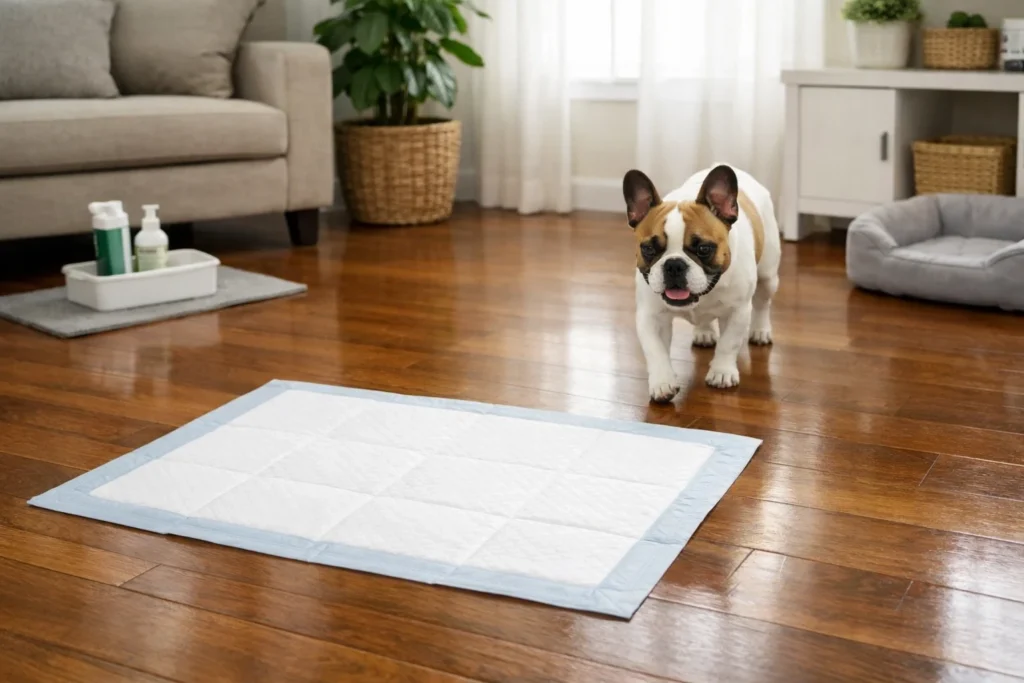
Why Dog Pee Pads Slip In The First Place
A pee pad usually slips for one of four reasons. First, the floor surface is too smooth. Tile, laminate, polished wood, and some vinyl floors do not give much grip. Second, the pad is too light for the dog’s movement. Many dogs circle before they pee. Some scratch the surface first. Some step partly on and partly off the pad. If the pad is light, it moves. Third, the pad is too small, so the dog lands on the edge and pushes it away. Fourth, the potty area is too open, so the dog keeps approaching from different angles and shifting the pad out of place.
That last point matters more than many people think. AKC says that if you use pee pads, you should put the pad in one place in the house, ideally near the door if you may later transition to outdoor potty habits. That advice is useful for training, but it also helps reduce slipping. A fixed location means fewer setup changes, fewer floor transitions, and a more repeatable approach path for the dog.
Training style matters too. AKC says puppies need frequent trips to the potty area, and very young puppies may need them as often as every 15 minutes. Humane World for Animals and Blue Cross both stress close supervision, fast response to potty signals, and immediate praise when the dog gets it right. If the owner is late, the dog rushes, steps awkwardly, or starts peeing while moving. That can make a sliding pad even more likely. In other words, some slipping problems are product problems, but some are timing problems.
The Best Way To Stop A Pee Pad From Sliding
The most reliable fix is a pee pad holder tray. This is the first thing we would suggest when a customer says the pad moves every time the dog steps on it. Preventive Vet says a holder tray gives the pad a more obvious border, which helps dogs see where the potty area begins and ends. It also points out that holder trays make it harder for dogs to grab the pad and chew it. For many homes, that solves two problems at once.
A holder tray works because it adds structure. The pad stays flatter. The corners stay put. The dog steps onto a defined area instead of a loose sheet. If your dog tends to miss the pad, circle a lot, or paw at it before using it, a tray usually gives the fastest improvement. This is especially true on tile or hardwood floors.
A holder tray can also help older dogs. Preventive Vet specifically notes that senior dogs may appreciate a holder if the pad slips on hard floors. That detail matters. A young puppy may recover fast from one bad step. A senior dog may not. Once an older dog loses trust in the surface, indoor potty use can become much harder.
If your dog is very small, a litter-box-style indoor dog toilet or low-sided tray can also work well. AKC even suggests considering an indoor “litterbox-type” dog potty station as part of pad training. That kind of setup gives a clear potty zone and limits movement around the edges.
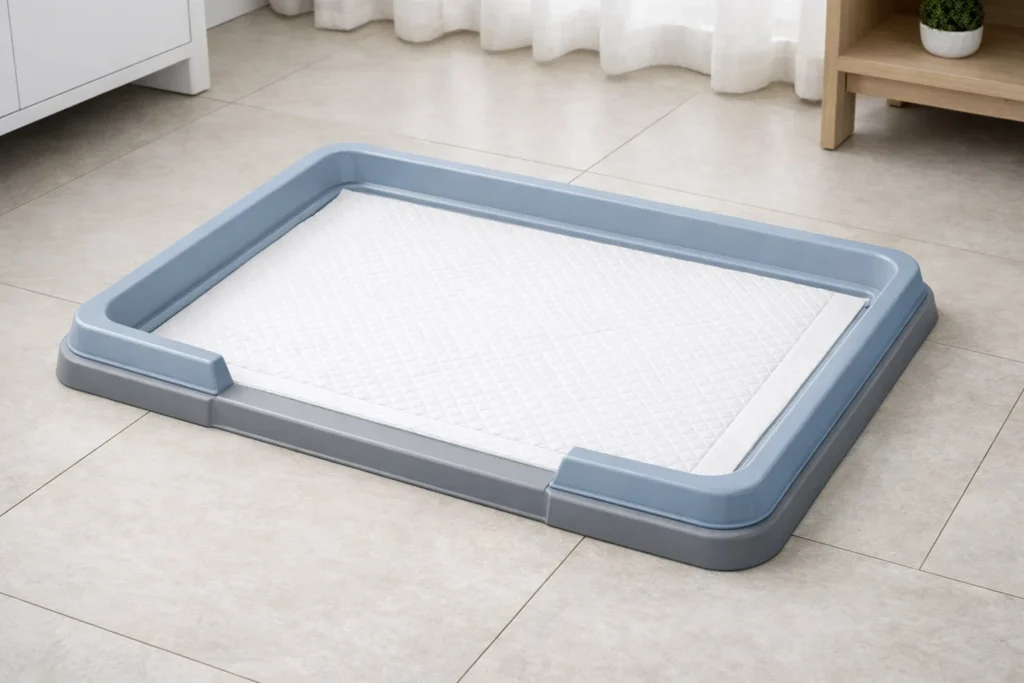
Use Adhesive Corners When The Floor Allows It
If you do not want to use a tray, the next best fix is a pad with adhesive tabs أو sticky corners. The Spruce Pets, in its tested review of puppy pads, found that optional adhesive tabs help keep a pad in place. It specifically noted that this is useful for dogs that paw at the pad before using it. That is a small product feature, but in real use it makes a big difference.
From a product point of view, this is one of the clearest places where design supports training. A dog does not need the pad to be perfect. It just needs the pad to stay where the dog expects it to be. Adhesive corners can do that on many hard surfaces.
Still, there is one caution. The same Spruce Pets testing notes that some sticky tabs can leave a bit of material behind on certain floor surfaces, though it was easily removed in their testing. So this fix is practical, but it should be matched to the floor type. If the floor finish is delicate, a holder tray is usually the safer option.
At Carecon™, we would treat adhesive corners as a strong option for homes that want a low-profile setup without adding a tray. They are simple. They are easy to explain to buyers. They also solve a real pain point fast.
Make The Potty Area Smaller And More Defined
Sometimes the pad slips because the dog does not have a defined indoor toilet area. The pad is placed in the middle of a room. The dog comes at it from any direction. Toys roll over it. People walk past it. The dog gets distracted, spins, and pushes the pad away. This is why a contained potty zone often works better than a single loose pad in an open room.
AKC says that when you cannot supervise closely, you can place the puppy in a crate or safe area. Humane World for Animals also supports using a small restricted area when close supervision is not possible. While those sources are talking about general housetraining, the same logic helps with pad slipping. A playpen corner, laundry zone, or gated area reduces traffic and gives the pad a fixed place in the home.
This does not need to be complicated. In many homes, the best place is a quiet corner near an easy-to-clean wall, away from the dog’s bed and food, but still easy to reach. If the long-term goal is outdoor training, AKC says placing the pad near the door can help later. That can also reduce slipping because the pad is less likely to be moved around from room to room.
Preventive Vet adds another useful idea here. It says the dog may understand the potty area better when the pad has a clear edge. That means you are not only trying to stop sliding. You are trying to make the toilet target more obvious. A better boundary often brings better aim.
Choose A Bigger Pad Than You Think You Need
A lot of slipping starts at the edge. The dog places one paw on the pad and one paw off it. Then the body weight shifts and the pad skids. This is why pad size matters more than many buyers expect.
The Spruce Pets notes that disposable pads come in several sizes and highlights larger options among the tested products. In practical use, a larger pad gives the dog more margin for circling, sniffing, and adjusting body position. It also lowers the chance that one paw lands on the corner and shoves the whole pad forward.
From our point of view at Linyi CareCon Import & Export Co., Ltd., this is a common buying mistake. Many people choose pad size based only on dog size. But the better way is to think about dog size plus movement style. A calm toy breed may do fine on a compact pad. A nervous puppy that turns three times before peeing may need much more room, even if it is small.
If the dog keeps stepping off the side, do not only ask how to secure the pad. Ask whether the pad is too small for the dog’s natural movement.
Try A Washable Pad With Better Grip Or Use A Grip Layer Under It
Washable pads can be a good choice in many homes, but they are not always the best answer for slippery floors unless they have a real non-slip backing. The Spruce Pets found that one washable pad option moved around on hardwood or tile, and another reusable pad had no traction on the backside to keep it from slipping. That does not mean washable pads are bad. It means buyers should pay close attention to the backing, not only the absorbency.
So if you want to use a reusable pad, look for a version with grip on the underside or place it inside a contained space, such as a crate or tray setup. The same Spruce Pets review notes that low-traction reusable pads work better in contained areas when slipping is a concern.
This is also where a simple support layer can help. A thin non-slip mat under a holder tray, or under a washable pad if the manufacturer says it is safe, can improve stability. This is more of a household setup decision than a training rule, but it works best when combined with the training basics from AKC and Humane World for Animals: one location, routine, and close supervision.
Keep The Dog From Rushing Onto The Pad
Not every slipping problem starts with the product. Some start with the dog arriving too fast. If the owner notices potty signs late, the dog hurries, spins, or half-steps onto the pad. Blue Cross says common signs include sniffing the floor, circling, looking restless, or returning to a room where the dog has toileted before. Humane World for Animals says similar things and recommends taking the dog to the potty spot right away when these signals appear.
This matters because a dog that reaches the pad in a calm way is less likely to shove it across the floor. Good timing reduces frantic movement. It also increases the chance that the dog steps fully onto the pad.
AKC says to take puppies to the potty pad frequently and to reward them right after they go in the correct place. Humane World for Animals says the same thing about rewarding immediately. That reward timing helps build confidence in the spot itself. The dog starts to approach the potty area with more certainty and less hesitation.
At كيركون ™ Carecon, we see this as an important buyer education point. A stable pad helps the dog. A stable routine helps just as much.
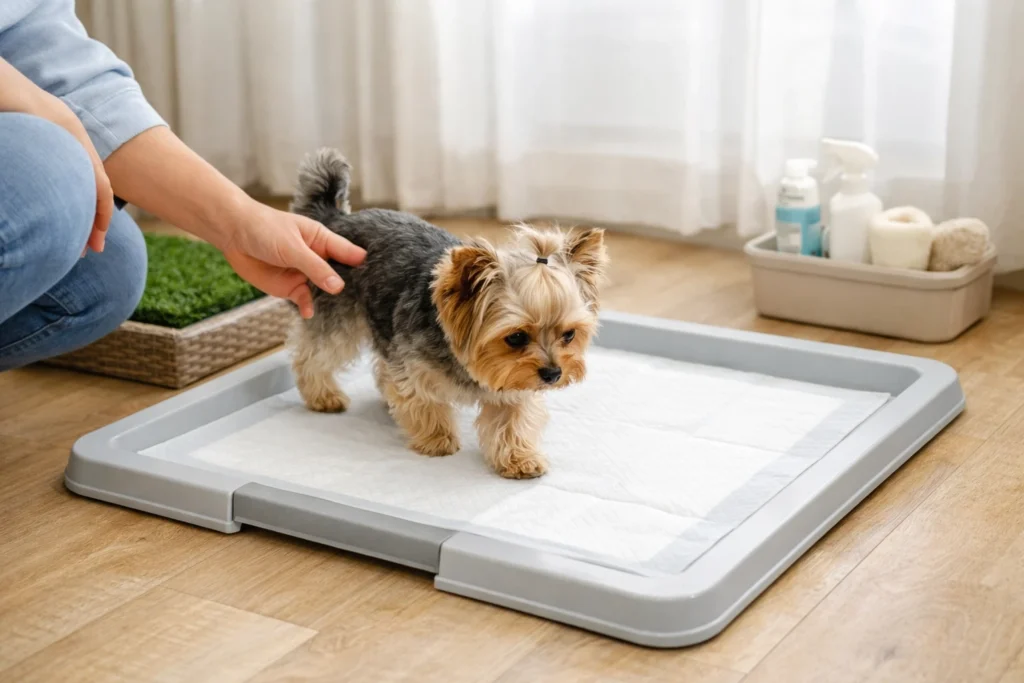
Clean Around The Potty Area The Right Way
A slipping pad often comes with another issue: missed spots nearby. When urine lands partly on the floor, the area may keep drawing the dog back. Blue Cross says to clean indoor messes thoroughly and to avoid ammonia-based cleaners such as bleach because they may encourage the puppy to use the same area again. Humane World for Animals also says soiled areas should be cleaned well to remove scent that may trigger repeat accidents.
That matters for slipping because once the dog starts targeting the floor next to the pad, the training problem gets bigger. The goal is not only to secure the pad. It is to keep the dog focused on the pad as the correct toilet zone.
A clean, dry, repeatable potty area is easier for the dog to understand. It also makes it easier for the owner to judge whether the slipping fix is working or whether the dog is actually aiming for the wrong place.
What Not To Do
Do not keep moving the pad from one room to another. AKC says the pad should stay in one place. A moving target makes training harder and often makes slipping worse because the setup changes each time.
Do not punish the dog for sliding the pad or missing it. Blue Cross says punishment is counterproductive and can frighten the puppy. Humane World for Animals says scolding slows progress and creates fear. If the dog slipped once and then got told off, the dog may start avoiding the whole potty area.
Do not assume all reusable pads are non-slip. Some are not. Check the backing. The Spruce Pets testing makes that clear.
Do not use a pad that is too small just because it is cheaper or easier to hide. A bad fit usually costs more later in wasted pads, floor cleanup, and slower training.
Our View At Carecon™
At Carecon™, we believe the best answer is practical. If a dog pee pad is slipping, the owner usually does not need a complicated trick. They need a more stable setup. In most homes, that means one or more of these steps:
- keep the pad in one fixed place
- use a holder tray for structure
- choose a larger size
- add adhesive corners when the floor allows it
- reduce open-room movement with a defined potty zone
- keep the routine calm and consistent
This is also why product design matters. A pee pad is not only an absorbent sheet. It is part of a training system inside the home. Stability, size, edge control, and surface behavior all affect whether the dog trusts the potty area.
الخاتمة
If you want to know how to keep a dog pee pad from slipping, the best fixes are usually simple. Start with the setup before blaming the dog. Put the pad in one place. Make the toilet area clear. Use a tray or holder if the floor is slick. Size up if the dog keeps stepping on the edge. Use adhesive corners if you want a flatter setup. Keep the routine steady. Reward success right away. Clean misses well. These steps match the practical housetraining guidance from AKC, Blue Cross, Humane World for Animals, Preventive Vet, and tested product reviews from The Spruce Pets.
From our perspective at Carecon™, a good indoor potty setup should feel stable for the dog and easy for the owner. When the pad stops sliding, the dog can focus on the habit. When the habit gets clearer, the home gets cleaner. That is the real goal.